Discover our Sensory Check.
Our Sensory Check: Travel with Forethought
TThis page isn’t just a corner for neurodivergent individuals; it’s a regulation tool for any family or traveller. Traveling means leaving your comfort zone, but when your family processes the world differently, information isn’t just “data”—it’s peace of mind. That’s why we created our Sensory Check: so that anticipation removes that knot in your stomach and you know exactly what to expect before leaving home.
To understand why we do this, you only have to look at my own family. Living with neurodiversity and high sensory sensitivity has taught us that typical stereotypes often fail. People often say that calm is found in the mountains, but absolute silence in nature can be “thundering” or unsettling for some. On the other hand, the predictable rhythm of a city can be exactly what helps a child focus.
This has taught us a clear lesson: every person processes stimuli in a unique way. What is a nightmare for one is a safe haven for another. That’s why we don’t label destinations as “good” or “bad”; instead, we provide factual sensory load data. This way, you are the ones who decide what fits your pace and what you prefer to skip on your adventure.
How Our Sensory Traffic Light Works
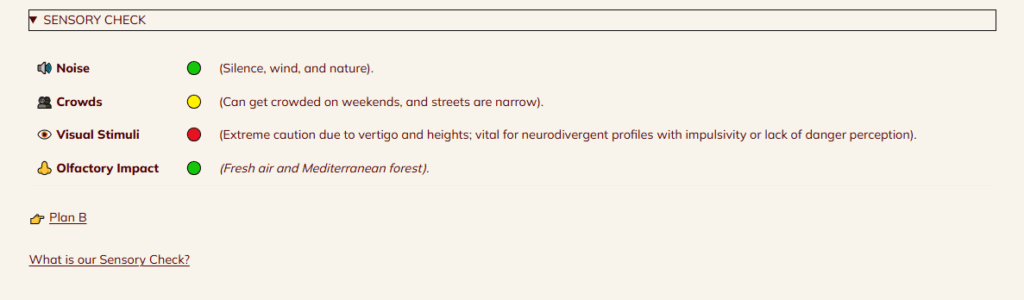
On the sidebar of our destination articles, you will find a quick color-coded evaluation (Green, Amber, Red) covering four key aspects of the destination:
- 🔊 Noise Level: From absolute silence to the roar of fireworks or massive crowds.
- 👥 Crowds (Personal Space): Exactly how much physical space you will have around you and whether there are quick escape routes.
- 👁️ Visual Stimuli: The impact of strobe lights, fire, constant movement, or extreme sun exposure.
- 👃 Olfactory Impact: The presence of strong odors, smoke, gunpowder, or dense markets.
This is How the Sensory Check Works in Practice:
The “Plan B” and Respite Points
Whenever the destination’s logistics allow, we include a detailed Plan B. If a hiking trail or the core of an event poses a risk of sensory overload or an emotional block, we will let you know if there is a drive-to alternative, exactly where to park, or if there is a quieter backup plan in the same area.
Additionally, during high-intensity events, we map out Respite Points: parallel streets or specific quiet zones where the intensity drops drastically, allowing you to rest and reset without having to leave the location entirely.
Our Golden Rule: Brutal Honesty
Some routes and destinations, by their very nature, cannot be adapted. If a historic castle requires climbing 200 uneven steps with no alternative, or if a festival is absolute chaos with no escape route, we will say so clearly.
We do not sugarcoat reality. So if a location is inaccessible or sensory overload is inevitable, we state it upfront so you can make the best possible decision for you and your family.